2025
NASA Robotics Proposal
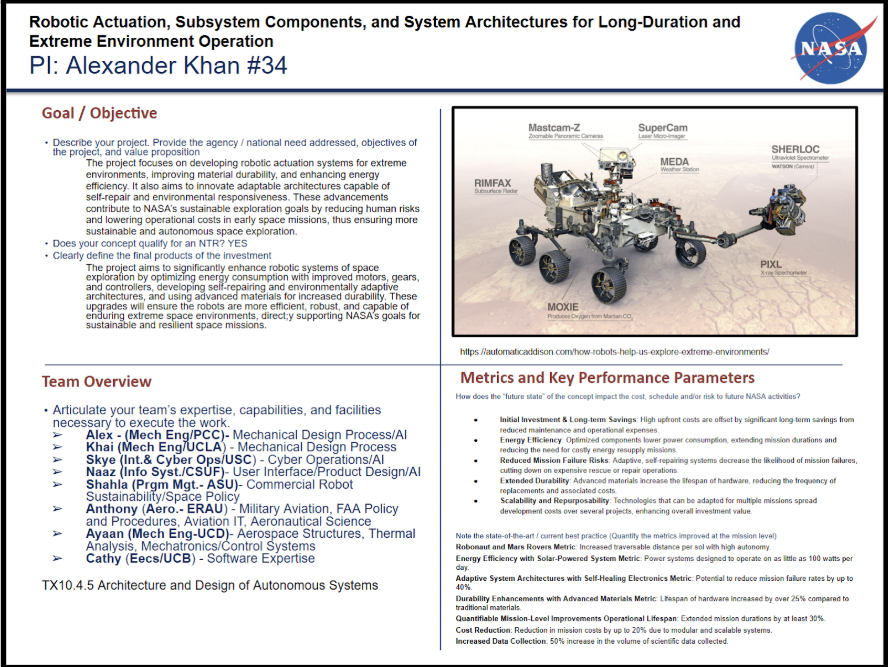
- Problem
- NASA's current robotic systems for extreme environments like Venus and Europa faced critical limitations in energy efficiency, durability, and autonomy that threatened long-duration mission viability.
- Approach
- Develop a self-repairing, AI-integrated robotic actuation system using advanced materials and energy-efficient actuators optimized for temperatures up to 600°C and pressures up to 100 bar
- Result
- Delivered a fully documented technical proposal as Principal Investigator of an 8-person team, projecting a 30% lifespan increase, 40% power reduction, and 20% mission cost savings over current state-of-the-art NASA rovers.
NASA Robotics Proposal
As Principal Investigator, I led an eight-person, multi-university team through the development of ExtremeOps, a NASA proposal for robotic actuation systems designed to survive long-duration missions in extreme environments like Venus and Europa. Our proposal addressed a real gap in current planetary exploration hardware. Existing systems like the Mars rovers and Robonaut lost too much operational life to energy inefficiency, maintenance demands, and environmental degradation. My team designed a system built around self-repairing electronic architectures, energy-efficient actuators, and AI-based fault detection, targeting a 30% increase in operational lifespan, a 20% reduction in mission costs, and a 40% cut in power consumption compared to the current state of the art. I handled initial problem identification and research, and I coordinated a team spanning mechanical, aerospace, electrical, and software disciplines across seven institutions.
Putting the proposal together required a broad mix of technical and organizational skills. I drew on mechanical design and CAD modeling to develop the initial system architecture and feasibility concepts for the actuation and subsystem components. I also managed the project's structure end to end, breaking the 10-12 month plan into three phases (concept and design, prototyping and testing, and final integration and demonstration), each with defined milestones, deliverables, and required expertise. That meant coordinating contributors across mechanical engineering, materials science, controls, and AI, while also writing the technical merit sections that positioned our proposal against NASA's own AREE rover concept. The project sharpened my ability to translate an open engineering problem into a phased, resourced work plan and to communicate that plan clearly to a technical review audience.
Gallery